
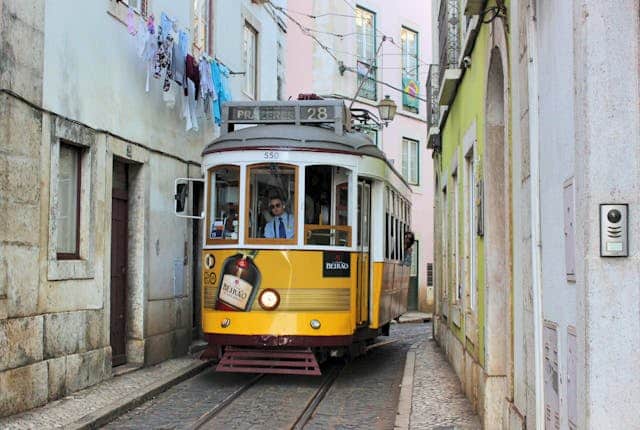
Tram 28 Lisbon: The Complete Guide for 2026
The most famous tram ride in Europe — and also one of the most misunderstood. Real 2026 fares, full route, the best stops, queue-beating strategies, pickpocket reality and the quieter alternative most tourists never hear about.
Lisbon’s Tram 28 is a transport line, a tourist attraction, and a symbol of the city, all at once. It is featured on more postcards than any other piece of public infrastructure in Portugal, and during peak season it carries somewhere between sixty and eighty passengers in each small wooden carriage built for forty. Some visitors love it. Others spend an hour queueing for it and another twenty minutes pressed against strangers, then declare it overrated. Both reactions make sense.
The honest answer is somewhere in between. Tram 28 really is one of the most scenic urban rides in Europe — it climbs and descends through neighbourhoods that no bus could reach, on tracks that have not moved since 1914. But whether you enjoy it or not depends almost entirely on when you board, where you board, and what you expect. This guide covers every detail with 2026 prices and timetables verified against Carris, plus the practical realities that most older guides skip.
Tram 28 in 60 seconds
If you only read one paragraph, here it is.
That is the entire summary. The rest of this guide explains why each of those numbers matters, where to spend your time once you have boarded, and how to avoid the two or three mistakes that turn a beautiful 45-minute ride into a frustrating 90-minute ordeal.
The full route: 36 stops, two directions
Tram 28 is technically known as line 28E — the “E” stands for eléctrico, the Portuguese word for electric tram. It runs as a single line in both directions, but because Lisbon’s old streets are too narrow for two-way tram traffic, the eastbound and westbound routes occasionally diverge by a block or two through one-way sections.
The line covers approximately 7 km (4.3 miles) and stops at roughly 36 official stops, depending on direction. End-to-end journey time is about 45 minutes when traffic is light, and can stretch to over an hour in the middle of the day when cars or delivery vans block the tracks (a daily occurrence in Alfama).
Here is the eastbound route, from west to east, with every stop in order:
Tram 28 stops · Campo de Ourique to Martim Moniz
- Campo Ourique (Prazeres) — Terminus
- Igreja Santo Condestável
- Saraiva de Carvalho
- Domingos Sequeira
- Estrela – Rua Domingos Sequeira
- Basílica da Estrela
- Calçada da Estrela / Rua Dr. Teófilo Braga
- Calçada da Estrela / Rua Borges Carneiro
- São Bento / Calçada da Estrela
- São Bento (Parliament)
- Poiais
- Calçada do Combro
- Santa Catarina
- Calhariz
- Praça Luís de Camões (Chiado)
- Rua Vitor Cordon / Rua Serpa Pinto
- Largo da Academia Nacional de Belas Artes
- Conceição (Baixa)
- Sé (Cathedral)
- Limoeiro
- Miradouro de Santa Luzia
- Largo das Portas do Sol
- Escolas Gerais
- Calçada de São Vicente
- Voz do Operário
- Graça / Miradouro da Graça
- Rua da Graça
- Sapadores
- Angelina Vidal
- Maria Fonte
- Maria Andrade
- Igreja dos Anjos
- Rua da Palma
- Praça Martim Moniz — Terminus
The reverse route (Martim Moniz to Campo de Ourique) follows the same stops in opposite order, with two minor street-level variations in Baixa and Chiado due to one-way streets. The stops in bold are the ones we cover in detail in the next section — the rest are perfectly fine to know about, but most visitors will not get off at them.
The 8 stops actually worth knowing about
Out of 36 stops, only a handful matter to a first-time visitor. Here is what is at each of the meaningful ones, in geographic order from east to west.
Praça Martim Moniz — eastern terminus
The official eastern starting point of the line, and one of the two places where you have any chance of boarding a tram with empty seats. It is a wide, somewhat utilitarian square at the foot of the Mouraria district, just a five-minute walk from Praça da Figueira and Rossio. Arrive early (before 9 AM) and you may walk straight onto a waiting tram. Arrive at noon and you may queue for 20 to 40 minutes.
Graça / Miradouro da Graça
The first major hilltop the tram climbs to from Martim Moniz. The Miradouro da Graça is a wide terrace with panoramic views over Lisbon’s old town and the castle. There is a kiosk selling drinks, a pine tree that has appeared in more photographs than anyone can count, and an excellent fado bar (Damas) two blocks away. Get off here if you want to spend half an hour just looking at the city.
Largo das Portas do Sol
Top pick One of the two best viewpoints on the entire route, and arguably one of the best in Lisbon. Portas do Sol overlooks Alfama with its tiled rooftops cascading down towards the Tagus river. There is a famous café terrace, a kiosk with the same view at half the price, and a statue of Saint Vincent watching it all from above. From here you can walk down into Alfama or up the back streets to Castelo de São Jorge in about ten minutes.
Miradouro de Santa Luzia
One stop after Portas do Sol — they are within walking distance of each other and most visitors do both. Santa Luzia has a smaller terrace covered in azulejo tile panels and bougainvillea. It is slightly less crowded than Portas do Sol but the view is essentially the same. Combine the two.
Sé (Cathedral)
The Sé de Lisboa is the city’s oldest cathedral, built in 1147 on the site of a former mosque. The tram stops directly in front of the main façade, which means the most photographed shot in Lisbon — a yellow tram passing in front of a Romanesque cathedral — happens here several times an hour. Inside, the cathedral is austere; outside, it is a perfect frame.
Praça Luís de Camões (Chiado)
The heart of Lisbon’s elegant Chiado district. Get off here for the bookshops (including the historic Bertrand, which is in the Guinness Book of Records as the oldest still in operation), the cafés (A Brasileira, with Pessoa’s statue outside), and the Carmo ruins five minutes uphill. From this stop, both Bairro Alto and Baixa are within walking distance.
São Bento
The tram passes directly in front of the Portuguese Parliament — an imposing neoclassical building with broad steps. Few visitors get off here unless they have a specific interest, but it makes for a striking photograph from the moving tram.
Basílica da Estrela
The other strong contender for “best stop on the line.” The Basilica is a beautiful 18th-century white-domed church that sits across from the Jardim da Estrela, one of Lisbon’s loveliest small parks. The neighbourhood (Estrela / Campo de Ourique) is genuinely residential, far less touristed than Alfama, and home to some of the best food shops and bakeries in the city. This is also where you can switch to Tram 25 to head back to Baixa via a different route.
Campo de Ourique (Prazeres) — western terminus
The end of the line, in the elegant residential district of Campo de Ourique. The “Prazeres” in the name refers to the large 19th-century cemetery just up the street — a quiet, almost park-like place worth visiting if you have an hour to spare. The Mercado de Campo de Ourique, one of the city’s best food markets, is also a short walk away.
Tickets: how much it really costs in 2026
Tram 28 uses the same ticketing system as the rest of Lisbon’s public transport, but with one big catch: buying onboard is much more expensive than buying in advance. The price difference is the single most important thing to know before you board.
| Option | 2026 price | Where to buy | Best for |
|---|---|---|---|
| Onboard ticket | €3.30 | From the driver (cash) or NFC terminal (cards only) | One ride, no card prepared |
| Carris/Metro single | €1.90 | Metro vending machines, Navegante card needed | One ride with prepared card |
| Zapping | €1.72 | Pay-as-you-go credit on Navegante card | Most visitors — best value |
| 24-hour pass | €7.25 | Metro stations, Carris offices | 3+ rides on Carris/Metro the same day |
| Lisboa Card (24h) | €31 | Tourist offices, Lisboa Card website | Museum-heavy itinerary |
The arithmetic is straightforward. If you only need to ride Tram 28 once and you do not already have a Navegante card, paying €3.30 onboard is the lazy choice and still cheaper than a coffee. If you are riding Tram 28 plus the metro and other trams the same day, the €7.25 day pass pays for itself by the third ride. If you are doing museum-heavy sightseeing, the Lisboa Card includes tram 28 for free along with everything else.
The single biggest mistake visitors make is buying tickets onboard out of habit when they already have a Navegante card in their pocket. Always tap your card on the orange validator near the tram doors — the system charges the cheaper Zapping fare automatically. Full details on which card suits which itinerary in our Tickets & Cards guide.
Schedule and frequency
Tram 28 runs every day of the year, including weekends and public holidays. The official 2026 timetable, published by Carris, gives the following operating window:
- First tram of the day: approximately 6:00 AM from both termini.
- Last tram of the day: approximately 10:30 PM (on weekdays), with some late services running closer to 11 PM in summer.
- Frequency in peak hours (7 AM – 7 PM): every 10 to 12 minutes.
- Frequency in off-peak hours: every 15 to 20 minutes.
Note that between roughly 9:30 PM and the end of service, the route is shortened on some runs — trams terminate at Estrela rather than continuing to Campo de Ourique. This catches out visitors heading to Campo de Ourique for late dinner. If you are travelling after 9 PM, check the destination sign at the front of the tram (it shows either Prazeres or Estrela) before boarding.
How to board and actually get a seat
Boarding Tram 28 between 10 AM and 6 PM in any season other than deep winter means joining a queue. Boarding it during July and August at any time of day means joining a long queue. The trams are small — 20 seats, 38 standing places officially — and the demand outweighs the supply by a wide margin.
The strategies that actually work, in order of effectiveness:
1. Board at one of the two termini
The only places where the tram empties completely before refilling. Campo de Ourique (Prazeres) and Martim Moniz are where you should be if you want any chance of a seat. Boarding at any intermediate stop means competing with passengers who have already been queuing further down the line.
2. Go early
Arrive at the terminus before 9 AM and you can usually walk straight onto a tram. By 10 AM, expect a 15-minute wait. By noon in high season, the wait can stretch to 45 minutes.
3. Go very late
After 8 PM, the crowds thin noticeably. The light is also better for photographs of the city at this hour, and the temperature is more pleasant in summer. The trade-off is that the last full-route service is around 9:30 PM (after that, some trams terminate at Estrela).
4. Reverse the popular direction
Most tourists start at Martim Moniz because it is closest to the historic centre and the major hotels. This means the queue at Martim Moniz is longer than the queue at Campo de Ourique most of the day. Take a bus or metro to Campo de Ourique first (it is a pleasant neighbourhood worth visiting anyway), and board there. You will likely walk straight onto a tram, get a window seat, and see the entire route at your own pace.
5. Where to sit
The right-hand side of the tram (when facing the front) generally has the better river views from Portas do Sol to Sé. The left-hand side has the better views as the tram climbs through Graça. Window seats by the doors fill up first and have the most awkward angles for photographs. The two single seats at the very front of the tram (behind the driver) are the most coveted in the entire fleet.
Pickpockets: what is actually true
Every guide to Tram 28 mentions pickpockets, and they are right to. This is the single highest-density pickpocketing environment in Lisbon, and one of the most active in any European city. We mention it here not to scare you but because awareness genuinely reduces risk.
What is actually happening, statistically: organised teams of three to five people work the most crowded sections of the line, especially between Praça Luís de Camões and Martim Moniz (the central tourist stretch where the tram is always packed and the streets are narrow). They board at busy stops, position themselves in the crush of standing passengers, and rely on tight spaces, distracted tourists and slow exits to operate.
The objects most commonly taken: smartphones (especially when held up for photographs), wallets in back pockets, and the contents of unzipped bags or backpacks worn behind the body. Cash is a target only when visible. Pickpockets here are skilled but not violent — there are essentially no incidents of mugging or aggressive theft on the line.
The defensive measures that actually work:
- Backpack worn on your front in any crowded section. This single change eliminates the most common method of theft.
- Phone in a zipped pocket or front pocket of a closed bag. Avoid using your phone while standing in a crush — that is precisely when you are most vulnerable.
- No wallet or phone in back trouser pockets, ever. Treat back pockets as if they had no fabric at all.
- Bags closed and held in front of you in standing-room sections. Crossbody bags are fine if the zip is at the front.
- Be especially alert when the tram fills up at a busy stop. The moment of crowd movement is when most thefts happen.
You do not need to be anxious — you need to be aware. Lisbon is a safe city overall, and Tram 28 thefts are nearly always opportunistic rather than confrontational. Reasonable precautions eliminate most of the risk.
The local alternative: Tram 12E
One of the best-kept secrets of Lisbon’s tram network is that Tram 28 is not the only vintage tram running through Alfama and Graça. Tram 12E covers a shorter loop through some of the same neighbourhoods using the same charming Remodelado carriages — and is largely ignored by tourists.
Tram 12E runs from Praça da Figueira through Mouraria, Graça, and Alfama, and back to Figueira, in a loop of about 25 minutes. The route includes Largo das Portas do Sol, Miradouro de Santa Luzia, Sé and Martim Moniz — essentially the most photogenic central stretch of Tram 28 — without the queues and with significantly lower pickpocket risk.
The trade-off: Tram 12E does not cover the western half of Tram 28’s route (Chiado, São Bento, Estrela, Campo de Ourique). If you specifically want to see the Basílica da Estrela or visit Campo de Ourique, you still need Tram 28. But if your goal is “a charming ride through old Lisbon in a vintage yellow tram with views over Alfama,” Tram 12E delivers exactly that, more comfortably and at the same €1.72 Zapping fare.
Small things that make the trip better
A handful of details that experienced visitors learn on their second trip:
- Sit on the left when going east (towards Martim Moniz) for the best Alfama views.
- Sit on the right when going west (towards Campo de Ourique) for the best São Bento and Estrela views.
- Validate every time, even on transfers. Inspectors do check, and fines for an unvalidated ride start at €70.
- Press the red “parar” button before your stop — the tram only stops on request at intermediate stations.
- If the tram is full, wait for the next one. Pushing on at a busy stop is how thefts happen, and the next tram is rarely more than 15 minutes away.
- Strollers and large luggage do not fit. The aisle is barely wide enough for two people to pass. If you are travelling with a stroller, use the metro or a bus.
- Photography rule of thumb: take photos from the tram, not of the tram with your phone hanging out the window. Phones get snatched.
- The trams are not air-conditioned. In July and August, they get genuinely hot. Carry water.
- Strikes happen. Carris workers strike one or two days a year, announced in advance. Check the Portuguese news the day before any tightly scheduled trip.
Frequently asked questions
How much does Tram 28 cost in 2026?
A single ticket bought onboard from the driver costs €3.30. The same ride costs €1.90 with a standard Carris/Metro single ticket loaded onto a Navegante card, or €1.72 if you use Zapping pay-as-you-go credit. A 24-hour pass covering Tram 28 and all other Carris and Metro services costs €7.25.
Where does Tram 28 start and end?
Tram 28 runs between Praça Martim Moniz (eastern terminus, near central Lisbon) and Campo de Ourique / Prazeres (western terminus). The full route is approximately 7 km and takes about 45 minutes end to end, passing through Graça, Alfama, Baixa, Chiado, São Bento and Estrela.
What time does Tram 28 start running?
The first tram of the day leaves both termini at approximately 6:00 AM. The last full-route tram runs around 9:30 PM, after which some services terminate at Estrela rather than Campo de Ourique. The final tram of the night runs around 10:30 PM.
How often does Tram 28 run?
Tram 28 runs every 10 to 12 minutes during peak hours (7 AM to 7 PM), and every 15 to 20 minutes during off-peak hours. Actual frequency varies due to traffic delays in Alfama, where cars and delivery vans frequently block the tracks.
Is Tram 28 worth it?
Yes, if you board at a terminus early in the morning or after 8 PM, and treat it as a 45-minute scenic ride rather than a hop-on hop-off tour. No, if you join the midday queue at Martim Moniz expecting to sit by a window — in which case Tram 12E offers most of the same experience with far fewer crowds.
Is Tram 28 safe?
Tram 28 is physically safe — there are no incidents of violence on the line. The main risk is pickpocketing, which is statistically high, especially between Praça Luís de Camões and Martim Moniz. Standard precautions (backpack worn on front, no valuables in back pockets, phone zipped away) eliminate most of the risk.
How do I get a seat on Tram 28?
Board at one of the two termini — either Praça Martim Moniz or Campo de Ourique. These are the only places where the tram empties completely before refilling. Arrive at the terminus before 9 AM for the best chance of a seat. Boarding at intermediate stops means competing with passengers already seated.
What is the difference between Tram 28 and Tram 12E?
Tram 12E is a shorter circular route (about 25 minutes) through Mouraria, Graça and Alfama using the same vintage carriages as Tram 28. It covers the most scenic central section of the Tram 28 route without the long queues, but does not extend to Chiado, São Bento or Campo de Ourique. For visitors who only want the Alfama experience, Tram 12E is often the better choice.
Does the Lisboa Card include Tram 28?
Yes. The Lisboa Card includes unlimited rides on Tram 28 along with all other Carris and Metro services, for the duration of the card (24, 48 or 72 hours). Whether the Lisboa Card itself is worth buying depends on how many paid attractions you plan to visit, since transport is only one of its components.
A note on our research
All prices and schedules in this guide are verified against official 2026 sources, including Carris for fares and timetables, and cross-referenced with reader reports for queue patterns and pickpocket hotspots. Fares change occasionally — usually in January — and we revisit each guide after every announced update. If you spot anything out of date, please let us know.